Yes, you can ship batteries from China, including lithium-ion batteries on their own. They travel as dangerous goods, so they need the right UN number, test reports, packing and labels, and not every carrier or route will take them. This guide explains the battery types, the documents you need, which shipping methods work, and what to check before you import batteries into the USA, UK, EU or Canada.
Key points
• Lithium batteries are Class 9 dangerous goods. They can go by sea, air and in some cases express, but each has its own limits.
• Every lithium battery type needs a UN38.3 test report and a safety data sheet (MSDS). Air shipments from China also need a transport condition report.
• Batteries shipped on their own (UN3480) are the most restricted: by air they can only fly on cargo aircraft.
• Selling batteries abroad can also require product certification, such as CE, UKCA or UL. We can arrange both the shipping documents and the certification.
Can you ship batteries from China?
Yes. China produces most of the world’s lithium batteries, power banks, e-bike batteries and battery-powered products, and they are shipped every day. Because lithium batteries can overheat or catch fire if damaged or short-circuited, international rules (the IMDG Code for sea freight and the IATA Dangerous Goods Regulations for air) treat them as Class 9 dangerous goods. That does not stop you shipping them. It means the battery must be tested, packed and declared correctly, and booked with carriers that accept dangerous goods.
Battery types and UN numbers
The UN number decides which rules apply. Your supplier’s documents should state it; if not, we check it for you.
| What you ship | UN number | Typical products |
|---|---|---|
| Lithium-ion batteries on their own | UN3480 | Battery packs, cells, power banks, e-bike and energy storage batteries |
| Lithium-ion batteries packed with or inside equipment | UN3481 | Phones, laptops, tools with a spare battery, electric scooters |
| Lithium metal batteries on their own | UN3090 | Non-rechargeable lithium coin and cylinder cells |
| Lithium metal batteries packed with or inside equipment | UN3091 | Watches, remote controls, trackers, smoke alarms |
| Other batteries | Depends on type | Lead-acid, sodium-ion, alkaline and NiMH. Some are dangerous goods, some can ship as general cargo if protected against short circuits. |
Documents you need to ship lithium batteries
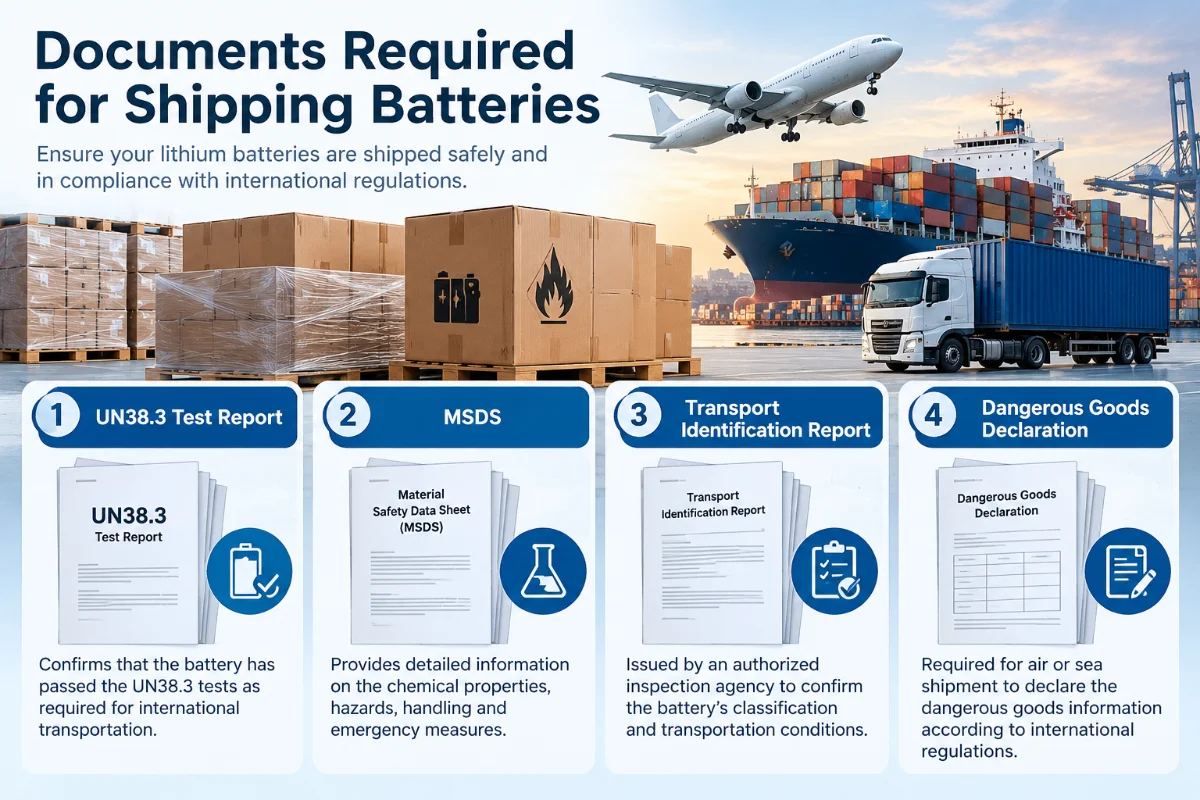
- UN38.3 test report. Every lithium cell and battery type must pass the UN38.3 tests (altitude, temperature, vibration, shock, short circuit and others). Carriers ask for the test summary before they accept the booking.
- Safety data sheet (MSDS / SDS). Describes the battery’s chemistry, hazards and handling.
- Transport condition report. For air freight from China, airlines and airports require a report from an approved testing body confirming how the battery may be transported. Sea freight often asks for one too.
- Dangerous goods declaration. Prepared for each shipment when the batteries are shipped as fully regulated dangerous goods.
No reports yet? Many suppliers, especially smaller ones, do not have current reports for every model. We can arrange the UN38.3 test, the MSDS and the transport condition report with accredited laboratories in China before your goods are ready, so the shipment is not delayed. Ask us about battery documents.
Sea, air or express: which can carry your batteries?
| Method | What it can carry | Things to know |
|---|---|---|
| Sea freight | All common lithium battery types, including large packs and energy storage batteries | The usual choice for volume. Needs a dangerous goods booking, so allow a few extra days to confirm space. FCL and some LCL services accept batteries. |
| Air freight | Batteries inside or packed with equipment on most flights; batteries on their own (UN3480) on cargo aircraft only | Strict limits on battery size, quantity per package and state of charge. Larger batteries and e-bike packs are often too big to fly. |
| Express courier | Mainly small batteries inside devices | Standard express services usually refuse batteries shipped on their own. Some dedicated battery express lines exist for small quantities. |
| Rail to Europe | Many battery types, case by case | Accepted on some China–Europe rail services with dangerous goods approval. We check the route for your product. |
For most importers, sea freight is the cheapest and simplest way to ship lithium batteries in volume. Read more about sea freight, air freight and express from China, or see the cheapest way to ship from China.
Packing and labelling rules
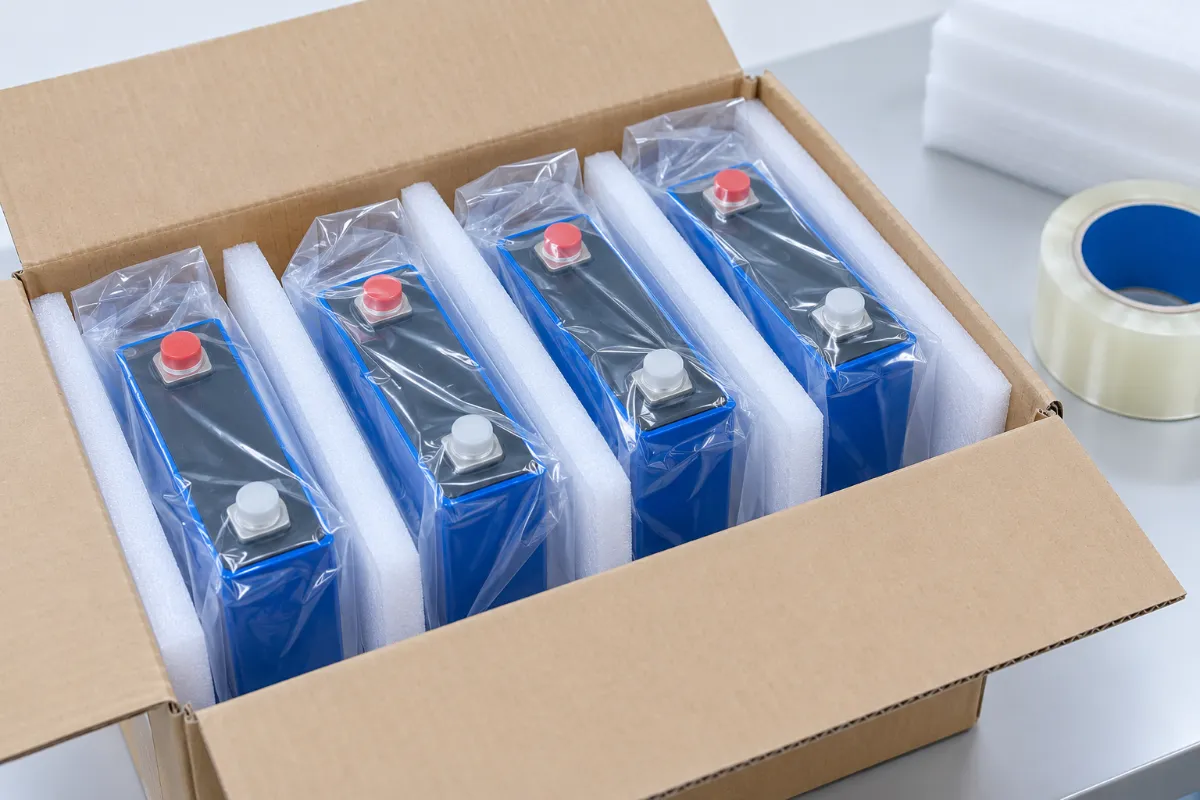
- Short-circuit protection. Terminals must be covered or each battery packed separately so they cannot touch metal or each other.
- Strong outer packaging. Batteries must not move inside the carton. Some packages must pass a drop test.
- State of charge. For air freight, lithium-ion batteries are shipped partly charged, usually at no more than 30%. Your factory needs to set this before packing.
- Labels and marks. The Class 9 lithium battery hazard label or the lithium battery mark, the UN number and a contact phone number, depending on the battery and quantity.
- Damaged or recalled batteries follow much stricter rules and cannot be shipped as normal cargo.
We check the cartons and labels at our warehouse before the goods leave China.
Importing lithium batteries from China
USA. Lithium-ion batteries from China pay normal duty plus additional tariffs on Chinese goods, and these have changed several times. Check the current rate for your HS code before you order. See import duties from China to the USA. Many retailers and marketplaces also ask for UL or IEC safety test reports.
EU. The EU Battery Regulation requires CE marking, battery labelling and registration with a producer responsibility scheme in each country where you sell. More requirements are being added step by step.
UK. Batteries need UKCA or CE marking where required, and sellers must register as battery producers under the UK waste battery rules.
Canada. Shipments follow the Transportation of Dangerous Goods rules, and most provinces have battery recycling programmes that sellers must join.
Product certification. Besides the shipping documents, we can help you arrange product testing and certification such as CE, UKCA, UL and IEC 62133 through accredited laboratories. If you do not want to handle customs at destination, we can also ship DDP with duties paid.
Checklist Before You Order Batteries
- Confirm the battery type and UN number for each product.
- Ask the supplier for the UN38.3 test summary and MSDS for each battery model.
- For air freight, check whether a transport condition report is needed.
- Check the watt-hour rating of each battery, which decides the air freight limits.
- Confirm the product certification your market needs (for example CE, UKCA, UL).
- Agree packing, labels and state of charge with the factory before packing.
- Ask your forwarder to confirm which method and route will accept the battery.
Timeline for a Battery Shipment
| Stage | Typical time |
|---|---|
| Collecting or arranging test reports | A few days if the supplier has them; longer if tests must be done |
| Dangerous goods booking | A few extra days compared with general cargo |
| Packing and label check | 1–2 days |
| Transit | As normal sea or air freight for the route |
How we ship your batteries from China
- Check. Send the battery specification, quantity and destination. We confirm the UN number, the best shipping method and which documents are missing.
- Documents. We collect your supplier’s reports or arrange the UN38.3 test, MSDS, transport report and any product certification you need.
- Booking and packing. We book dangerous goods space, collect from the factory and check packing and labels.
- Shipping and delivery. Export declaration, transport and customs clearance at destination, then delivery to your door or warehouse.
Shipping batteries from China: FAQ
Can lithium batteries be shipped by sea from China?
Yes. Sea freight accepts all common lithium battery types as Class 9 dangerous goods, with a UN38.3 report, an MSDS and correct packing and labels. It is the usual method for large quantities.
Can I ship lithium batteries on their own by air?
Yes, but only on cargo aircraft, at a limited state of charge and within size and quantity limits. Large packs such as e-bike batteries often have to go by sea.
What is a UN38.3 test report?
A report showing that the battery type passed the UN safety tests for transport. Carriers require it for every lithium cell and battery. If your supplier does not have one, we can arrange the test.
Can I import power banks from China?
Yes. Power banks are lithium-ion batteries on their own (UN3480), so they are usually shipped by sea or on cargo aircraft, with full dangerous goods documents.
Can e-bike batteries be shipped from China?
Yes, usually by sea as dangerous goods. Most e-bike batteries are too large for passenger aircraft, and many are above air freight limits altogether.
Can batteries be shipped by LCL?
Some LCL services accept dangerous goods, but not all. A full container gives more options. We check which services accept your battery.
Do you help with battery certification?
Yes. We can arrange the transport documents (UN38.3, MSDS, transport condition report) and product certification such as CE, UKCA, UL and IEC 62133 through accredited laboratories.
Checked on November 4, 2026. Dangerous goods rules are updated regularly and carriers can set stricter limits. This is a general guide, not legal advice; we confirm the requirements for your battery and route before booking. Send us your battery details.

 Scan to add us on WeChat
 WhatsApp +86 152 1895 5440