Buying from several factories in China is normal, but shipping each order separately is expensive: every shipment pays its own booking, documents, customs entry and delivery. Consolidated shipping combines goods from several suppliers into one shipment. This guide explains how consolidation works step by step, when it saves money and when it does not, what can go wrong, and how three of our US customers used it.
Key points
• Consolidation means collecting goods from several suppliers at one warehouse in China and shipping them together, as one LCL shipment or one full container.
• You pay one set of fixed costs (booking, export, bill of lading, import entry, delivery) instead of one per supplier.
• The warehouse is also the place to catch problems: late orders, damaged cartons and wrong packing lists.
• The biggest risk is one late supplier holding up everything. Plan for it before the first goods arrive.
What Is Consolidated Shipping?
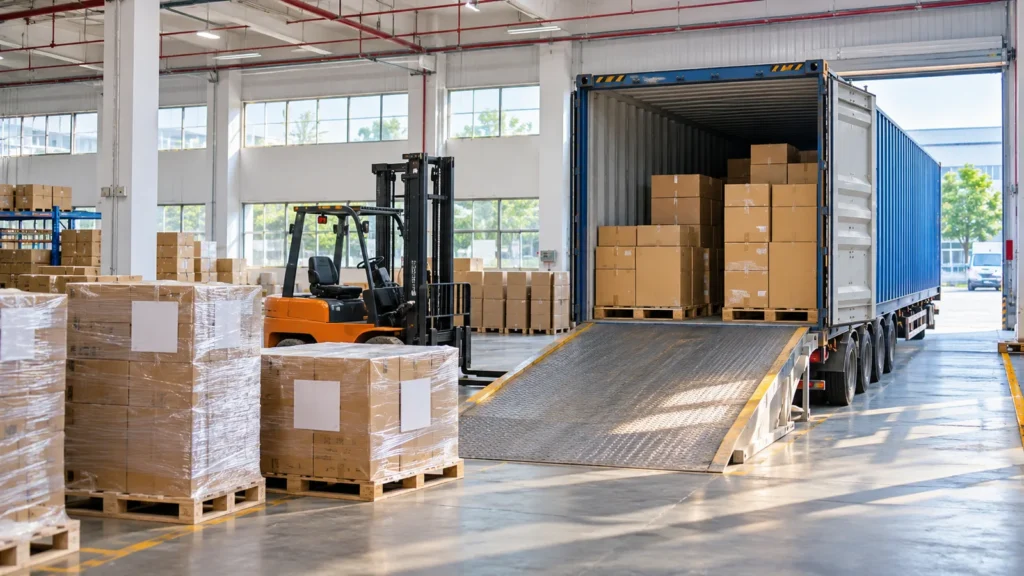
In consolidated shipping, each of your suppliers delivers its goods (or has them collected) to one consolidation warehouse in China. The warehouse receives and checks the cartons, keeps them until the last order arrives, and then ships everything together under one set of documents. Depending on the total volume, the combined goods travel as:
- One LCL shipment (shared container) for about 2–15 CBM. See LCL shipping from China.
- One full container (20ft or 40ft) when the combined volume reaches about 15 CBM or more. See container shipping costs.
- One air or express shipment for small, urgent orders.
The term is sometimes used for something different: a forwarder combining many customers’ small shipments into one container. That is LCL consolidation. This guide is about combining your own orders from several suppliers.
When Consolidation Saves Money
Every separate shipment carries fixed costs that do not depend on its size. With three suppliers shipped separately, you pay them three times:
| Cost | Three separate shipments | One consolidated shipment |
|---|---|---|
| Booking and origin handling | 3 times | Once |
| Export declaration in China | 3 times | Once |
| Bill of lading and documents | 3 sets | 1 set |
| Import customs entry and broker fee | 3 entries | 1 entry |
| ISF filing (USA) | 3 filings | 1 filing |
| Destination charges and delivery | 3 deliveries | 1 delivery |
| Receiving at your warehouse | 3 appointments | 1 appointment |
Volume matters too. Three orders of 5 CBM each are three small LCL shipments, but together they make about 15 CBM, where it is worth comparing one LCL shipment with a 20ft container. Once destination charges are included, a full container can come close in cost, and it arrives sooner because it is not unpacked with other cargo at destination. See LCL vs FCL.
When consolidation does not save money
- One supplier is much later than the others and the early goods are needed urgently.
- The suppliers are in very different regions, so collecting everything in one place costs more than it saves.
- Some goods need different transport (for example, batteries or dangerous goods that cannot travel with the rest). See shipping batteries from China.
- The orders are going to different destination countries or warehouses.
In these cases, a split plan is often better: ship what is ready, and consolidate the rest.
How Consolidation Works, Step by Step
| Step | What happens | Who does it |
|---|---|---|
| 1. Supplier list | You send each supplier’s name, address, contact, order reference and expected ready date | You |
| 2. Shipping marks | One set of shipping marks is agreed and sent to every supplier before they pack | You and the forwarder |
| 3. Delivery or pickup | Suppliers deliver to the warehouse, or the forwarder collects from each factory | Suppliers or forwarder |
| 4. Receiving and check | Cartons counted, measured and checked for damage against each packing list; results and photos sent to you | Warehouse |
| 5. Storage | Goods held until the last order arrives | Warehouse |
| 6. Repacking or labelling (if needed) | Damaged cartons replaced, labels or Amazon FBA labels applied, goods palletised | Warehouse, on your approval |
| 7. Documents | Packing lists combined into one; commercial invoice and export declaration prepared | Forwarder |
| 8. Loading and export | Goods loaded into the LCL consolidation or a full container; export customs cleared | Forwarder |
| 9. Transit, import and delivery | One shipment, one customs entry, one delivery | Forwarder and partners |
See shipping marks for how to label cartons from several suppliers so nothing gets mixed up.
The Readiness Matrix: Plan Before the First Goods Arrive
Before anything moves, put every supplier in one table. It shows at a glance whether the plan works:
| Supplier | City | Product | Cartons | CBM | Ready date | Urgent? |
|---|---|---|---|---|---|---|
| Supplier A | Shenzhen | Furniture frames | 120 | 18 | 10 March | No |
| Supplier B | Dongguan | Cushions | 200 | 22 | 12 March | No |
| Supplier C | Foshan | Table tops | 60 | 14 | 20 March | Yes, for a promotion |
This is an illustration. Here, the total of 54 CBM fits a 40ft high cube, but Supplier C is ten days later than the others. The options are to wait and ship one container, or to ship A and B first and send C separately. The matrix makes that decision visible early, instead of on the day the container is due.
Three Real Consolidated Shipments
These are recent shipments for our US customers:
| Furniture | Storage boxes and kitchen racks | Clothing and accessories | |
|---|---|---|---|
| Suppliers | 3, in and around Shenzhen | 2 | 4 |
| Method | Full container | LCL | LCL |
| Destination | Los Angeles warehouse | New York warehouse | Chicago warehouse |
| Pickup to delivery | 38 days from first pickup | 45 days | 42 days |
| Problem | One factory finished late | Some cartons arrived deformed | Four packing list formats; some quantities wrong |
| What we did | Collected ready goods in batches, held them at our warehouse, moved the loading date, shipped everything in one container | Replaced outer cartons, reinforced the packing, checked every carton number again | Checked cartons one by one, combined and corrected the documents before export |
In each case, the problem was found and fixed in China. Without a consolidation warehouse, the late order would have meant a second shipment, the damaged cartons would have arrived damaged, and the wrong packing lists could have caused questions at US customs.
What Can Go Wrong, and How to Prevent It
| Problem | Prevention |
|---|---|
| One supplier is late | Agree in advance whether to wait, split the shipment or move the urgent goods by air |
| Cartons cannot be matched to orders | Same shipping marks on every carton, with a supplier code and carton numbers |
| Carton count or quantity differs from the packing list | Count on arrival and report differences the same day, before the supplier is paid |
| Damaged or weak cartons | Check on arrival; agree who approves repacking and who pays |
| Documents in different formats | Ask each supplier for a packing list in one template, or let the forwarder combine them |
| Goods that cannot travel together | Tell the forwarder about batteries, liquids, magnets or powders before booking |
| Storage costs grow | Agree storage terms before the first goods arrive |
Documents for a Consolidated Shipment
Customs sees one shipment, so the documents must describe it as one:
- One combined packing list showing every carton, with marks, contents, quantities and weights.
- A commercial invoice matching the packing list, with product descriptions, values and HS codes. See commercial invoice and packing list.
- One bill of lading (sea) or air waybill (air).
- Export declaration in China. If some suppliers have no export licence, the forwarder can declare for them.
- For the USA, one ISF listing every manufacturer. See ISF filing.
Consolidation for Amazon FBA Sellers
Amazon sellers often buy one product from one factory and packaging or accessories from others. Consolidation lets you check and label everything in China, so the cartons arrive at Amazon ready to receive. Agree the FBA labels, carton weight limits and the Amazon warehouse before the goods ship, because Amazon may split one shipment across several warehouses. See Amazon FBA shipping from China.
Checklist: Before You Consolidate
- List every supplier with address, contact, order reference and ready date.
- Estimate the total CBM and weight, and decide LCL or full container.
- Send the same shipping marks to every supplier before packing.
- Ask each supplier for a packing list with carton sizes and weights.
- Decide what happens if one supplier is late.
- Agree what the warehouse checks on arrival and how you get the results.
- Agree storage time and any repacking or labelling.
- Confirm who clears customs at destination, or choose DDP. See DDP shipping.
Consolidation with JIEYI
- Warehouses in Dongguan, Shenzhen and Guangzhou, close to the factories most of our customers buy from.
- Pickup across Guangdong, or suppliers deliver to us.
- Carton checks on arrival: counts, sizes and condition against each packing list, with photos sent to you.
- Storage until your last order is ready, with the storage time agreed for each order.
- Repacking, labelling and combined documents before export.
- One shipment by LCL, full container, air or express, door to door or DDP.
See our freight consolidation service, or send us your supplier list and we will tell you the cheapest way to ship it.
FAQ
What is consolidated shipping from China?
Combining goods from several Chinese suppliers at one warehouse and shipping them together, as one LCL shipment, one container or one air shipment.
Does consolidation always save money?
Usually, because you pay one set of fixed costs instead of several. It may not when one supplier is much later, when goods must travel separately, or when suppliers are far apart.
How long can goods wait at the consolidation warehouse?
It depends on the volume and the order. We agree the storage time for each order before the first goods arrive.
Can you collect from my suppliers?
Yes. We collect across Guangdong, or your suppliers can deliver to our warehouse.
Do my suppliers need export licences?
No. If a supplier cannot declare exports, we can handle the export declaration.
What happens if a carton arrives damaged?
We photograph it and send you the photos before the goods ship. With your approval, we replace the outer carton or reinforce the packing before shipping.
Can consolidated goods go to Amazon FBA?
Yes. We can apply FBA labels in China and ship to the Amazon warehouse you are given.
Is it one customs entry for all suppliers?
Yes. The consolidated shipment has one bill of lading and one import entry, with every supplier’s goods on the combined invoice and packing list.
Updated on 4 November 2026. Buying from several suppliers in China? Send us the list and get a consolidation quote within 2 hours.

 Scan to add us on WeChat
 WhatsApp +86 152 1895 5440